Why a Routine Needs a Cue, Not Just a Good Intention
A routine needs a cue, not just a good intention. Learn to anchor a small habit to a visible object or daily event, then adjust it through the week.
Why does a routine disappear even when you genuinely want to do it? Often, the intention is clear, but the day offers no reminder of when to begin. A routine needs a cue, not just a good intention: something you can see or a familiar event that naturally marks its starting point.
That cue need not dictate your whole schedule. It can simply connect one small action to a moment already in your day, such as putting the kettle on, coming home, or turning off a lamp. The useful question is not “What time should I do this?” but “What will help me notice that it’s time?”
Choose a clear cue
A good cue is easy to notice and happens reliably enough to be useful. It may be physical, like your walking shoes beside the door, or tied to an everyday event, like finishing breakfast. Choose one that belongs to the routine’s real setting; a reminder hidden in another room is easy to miss.
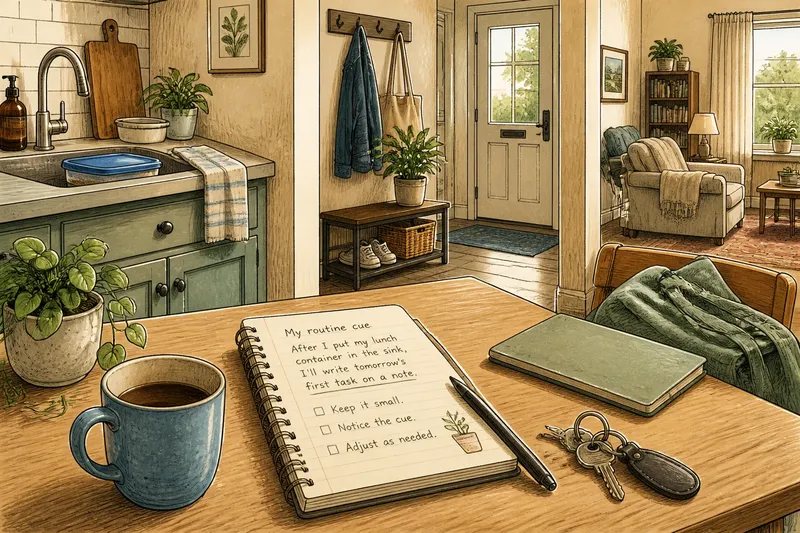
Try to link the cue to the action in plain language: “After I put my lunch container in the sink, I’ll write tomorrow’s first task on a note.” The cue is the container going into the sink; the routine is writing the note. Keeping the action modest makes the connection easier to recognize.
A cue can be visible without becoming another project. A notebook placed beside your keys may prompt a brief evening check-in. A folded reusable bag on a chair may remind you to put it by the door before a shopping trip. If the object is in the way, though, or creates clutter, choose a different cue.
Fit the cue to the routine
Start by naming the action you want to repeat and the place where it belongs. “Be more organized” is too broad to cue. “Put the mail in one tray after bringing it inside” gives you a specific action and a natural point of contact.
Then consider how the day actually unfolds. A clock time may suit a routine that needs a quiet window, but it can be brittle if work, meals, or caregiving shift from day to day. A recurring event often flexes more easily: after feeding the cat, after changing out of work clothes, or once the kitchen is cleared after dinner.
If the routine depends on a particular setting, let that setting provide the cue. Keep a crossword near the chair where you like to pause, or place a book on your pillow if reading is part of winding down. The point is not to stage the room perfectly; it is to make the next action visible where it can happen.
A week of gentle adjustment
Give the cue a week of ordinary use, treating the days as a chance to notice rather than a streak you must protect.
- Day one: Choose one small routine and one cue. Write the link in a short sentence and put any useful object where the action happens.
- Day two: Notice whether the cue appears at the right moment. If you walk past it while busy, make the action smaller or choose a calmer point in the day.
- Day three: Keep the cue, but remove a source of friction. For example, leave the pen with the notebook rather than expecting yourself to search for one.
- Day four: Check whether the cue still occurs when the day changes. If the usual event is missing, decide on a simple alternate cue, such as the next time you enter the room.
- Day five: Ask whether the routine feels like the action you meant to choose. If it has grown into a longer task, return to its smallest useful version.
- Day six: Look at the space around the cue. Keep what makes the action easier; move anything that turns the reminder into an annoyance.
- Day seven: Decide whether to keep, move, or replace the cue. A routine that still feels awkward may need a different anchor, not more self-scolding.
This is a review, not a pass-or-fail test. Missing a cue tells you something about its timing, visibility, or fit. It does not tell you that you lack the character to keep a routine.
When the day changes
Some days break the usual sequence. You may come home late, skip breakfast, or find the room you use occupied. A routine tied to only one narrow moment can vanish with it. A backup cue gives the action another possible opening without requiring a fixed schedule.
Say you want to water a houseplant, and your usual cue is making morning coffee. Imagine you leave early and never make coffee at home. You could choose a backup cue—seeing the plant when you return and put down your bag—so the observable result is a chance to notice its soil and decide whether watering is needed. The cue prompts attention; it does not require watering regardless of the plant’s needs.
For routines that should happen only under certain conditions, make the cue conditional. “After I bring groceries in, I’ll check what needs refrigeration” is clearer than “I’ll sort the kitchen later.” The event points to the action, while your judgment still determines what needs doing.
Questions about cues?
What if I forget the cue?
Make it more visible or connect it to an event you already notice. If you still miss it, choose another cue rather than adding a complicated reminder system to an already busy day.
Should I use an alarm or a physical reminder?
Use an alarm when timing matters and a notification is likely to help. A physical reminder suits routines tied to a place or object, such as setting out a tote by the door.
Can one cue trigger several routines?
It can, but several linked actions may make the cue feel demanding. Begin with one action; add another only if the original still feels clear and manageable.
What if the routine no longer fits?
Keep the useful intention and change the action or its cue. A routine should serve the shape of your day, not ask you to preserve a schedule that no longer matches it.
Skip the perfect setup
It is not worth buying a matching set of bins, designing a detailed tracking chart, or rearranging a room just to begin a small routine. A sticky note, a pen beside a calendar, or an object placed where you will see it may be enough. Choose a cue that helps without creating extra upkeep.
When you revisit your routine, use the main search question in practical terms: does the cue show up where and when the action can happen? If not, move the reminder, attach it to a different daily event, or make the action smaller. A well-chosen cue gives a good intention somewhere to land, while leaving room for the day to be a real day.