The Keepsake Question: What Makes an Object Worth Keeping?
The keepsake question helps you decide which sentimental objects deserve space by weighing memory, personal meaning, and the role an object still plays.
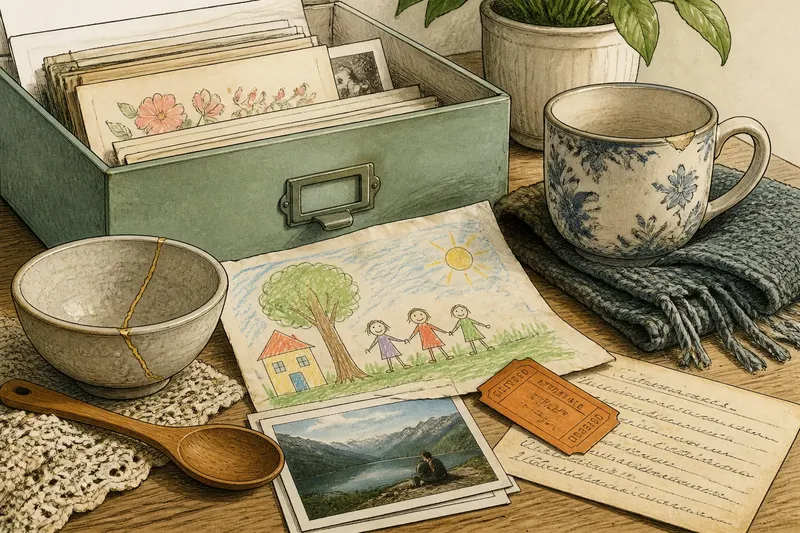
When you open the box of old birthday cards, the keepsake question is not simply which ones you can discard. It is which objects still give you something worth making room for. A chipped mug from a favorite aunt, a child’s lopsided drawing, and a ticket stub can each carry meaning, but they need not all carry the same kind.
Sentimental belongings are not failed attempts at tidiness. Keeping something can honor a person, hold a story, support a present-day ritual, or preserve a detail you would otherwise forget. The useful question is not whether an object is objectively important. It is what kind of connection it offers you now, and whether the object itself is the right way to hold that connection.
Meaning has different forms
Memory is often the first thing people mention, but it is only one part of attachment. An object may bring back a specific scene, represent a relationship, remind you of an earlier version of yourself, or stand for a possibility you still care about. Those meanings overlap, but separating them can make a difficult choice less foggy.
A handwritten recipe might recall a relative’s kitchen and also give you a meal you still make. A concert shirt might represent a friendship more than the event printed on it. A box of schoolwork might contain a few pages that show a child’s way of seeing the world, while the rest is mostly paper. The object’s value does not have to depend on its age, rarity, or condition.
It can help to name the connection in a plain sentence: “This reminds me of our Sunday breakfasts,” or “I like seeing how my handwriting changed.” If you cannot name anything beyond “I should keep it,” that does not settle the decision, but it reveals that obligation may be doing more work than affection.
Use can be part of memory
Some keepsakes remain meaningful because they still have a place in ordinary life. A serving bowl used at family gatherings carries a memory through repeated use. A scarf inherited from a friend may be worn on cold walks. These objects are not only records of the past; they take part in the present.
Use is not a requirement. Fragile or impractical things can matter deeply, and putting a delicate object away may be the respectful choice. But when an item can be used safely and you genuinely enjoy using it, separating it from “special things” can create an unnecessary barrier. A wedding tablecloth need not wait for a perfect occasion if its owner would be pleased to spread it over a table at an ordinary dinner.
There is a distinction between using an object because it brings pleasure and using it because you feel you ought to prove its worth. A favorite mug may be too precious for a crowded office kitchen, while a sturdy wooden spoon may feel good in your hand every time you cook. Let your actual relationship with the item guide its role.
Keep the object or its story?
Sometimes the memory is vivid while the physical item has become burdensome, easy to damage, or difficult to store. That does not mean the memory is less real. It means you can ask whether the object is the only form in which you want to keep it.
A photograph can preserve the look of a bulky school project. A short note can capture who gave you a souvenir and why it mattered. A recipe card can be copied into a notebook if the original is stained beyond use. These alternatives are not automatic substitutes: a photograph of a handmade toy does not feel the same as holding it. They are options when they suit the particular attachment.
Imagine you have a cracked ceramic bowl made by a friend who has since moved far away. You rarely use it, and the crack makes you nervous about handling it. You might photograph the bowl beside a note about the friend’s visit, then decide whether keeping the bowl in a protected cabinet still feels meaningful. The useful result is not a prescribed choice; it is a clearer sense of whether you want the object, the story, or both.
Space is part of the choice
Keeping an item has a practical side: it occupies a shelf, drawer, wall, or corner of your home. That cost does not cancel its emotional value. It helps you decide what form of keeping feels fair to the rest of your space and to the people who use it.
Consider the kind of place the object needs. A framed photograph may be part of a room’s daily life, while a stack of loose papers may be hard to enjoy in a crowded drawer. Grouping related items can sometimes make their meaning easier to see: a small box for letters, a labeled folder for children’s art, or a shelf for objects connected to a particular person. The aim is not to create a perfect archive. It is to make the things you choose to keep accessible enough that they do not become a hidden burden.
When a shared home is involved, sentimental value does not erase another person’s need for usable space. Talk about the location and limits that matter, rather than asking someone to defend the legitimacy of a memory. A partner may be comfortable with a keepsake box under the bed but not with every surface becoming a display. That is a negotiation about shared space, not a verdict on whose feelings count.
It is not worth the effort to devise an elaborate scoring system for every object or to force a decision while you are grieving, angry, or rushed. If an item is safe and space allows, setting it aside for a later conversation with yourself can be more useful than manufacturing certainty on the spot.
When is a keepsake worth keeping?
Does a keepsake have to be useful?
No. A keepsake can matter because it connects you to a person, place, or time, even if it has no practical function. Use is one kind of meaning, not a test every sentimental object must pass.
Should I keep every gift?
A gift can represent care without requiring permanent storage. You can appreciate the giver and the occasion while deciding that the object itself no longer belongs in your home.
What if family members disagree?
Ask what each person wants preserved and why, then discuss a workable place or form for it. If the item is jointly owned or has family significance, pause before making an irreversible decision and consult the people who have a genuine stake in it.
How do I decide about inherited items?
Separate your feelings about the person from your feelings about each object. You might keep one item you enjoy seeing or using, record the stories attached to others, and let the remaining belongings go when that feels appropriate.
A personal standard
A useful standard can be simple: keep an object when you value the connection it holds, enjoy its presence or use, or want to preserve its particular story. If none of those fits, consider whether a note, photograph, shared family record, or appreciative farewell would honor the memory better. You do not need the same answer for every item.
The keepsake question becomes gentler when it is not a referendum on love, gratitude, or loyalty. You can cherish a person without keeping every object associated with them, and you can keep something small without explaining its importance to anyone else. When you return to the question of what makes an object worth keeping, let the answer reflect the life you have with it now—not only the life it came from.